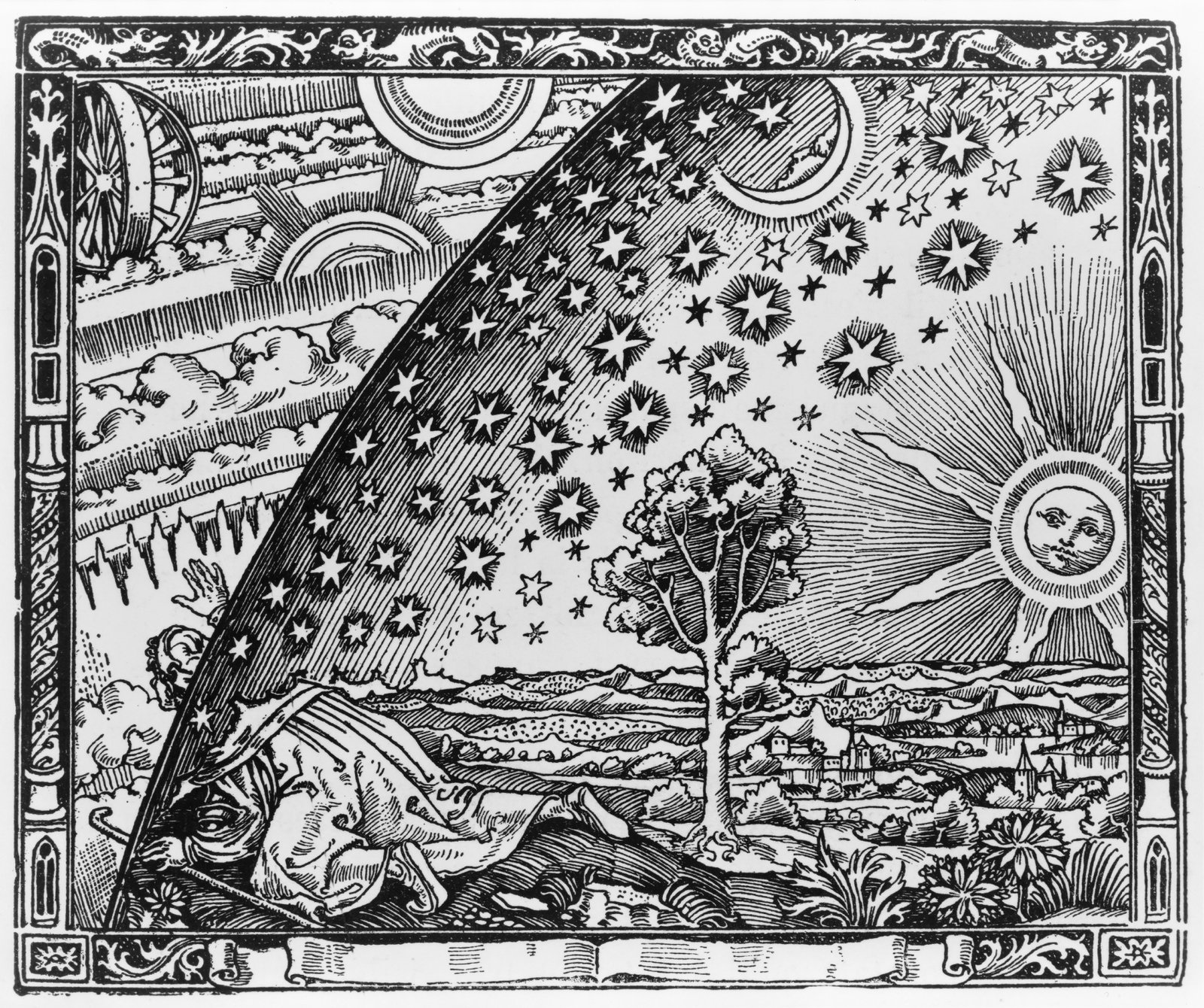
Camille Flammarion, L’Atmosphère: Météorologie populaire, Paris, 1888, p. 163
“A medieval missionary tells that he had found the point where the sky and the Earth touch…”
CRYSTAL 333
MODEL OF TIME-SPACE
CIRCULAR MATHEMATICS
[ −∞ 0 +∞ ]
Circumnavigating Infinity
An application of Circular Mathematics
by
Mac Waves
with ChatGPT Neo
Edition supervised by CUSTODIAN IGNIS of {R69}
www.museumofhearth.org
Entry Gate
Transcendental Node — Circumnavigating Infinity presents an experimental application of Circular Mathematics. It does not attempt to establish the complete theory of Circular Mathematics. Instead, it selects one mathematical object, defines it as precisely as possible, and tests its development through a sequence of transformations and applications. The broader concept of Circular Mathematics has been developed by the author for approximately twenty years; this book is one of its first systematic investigations.
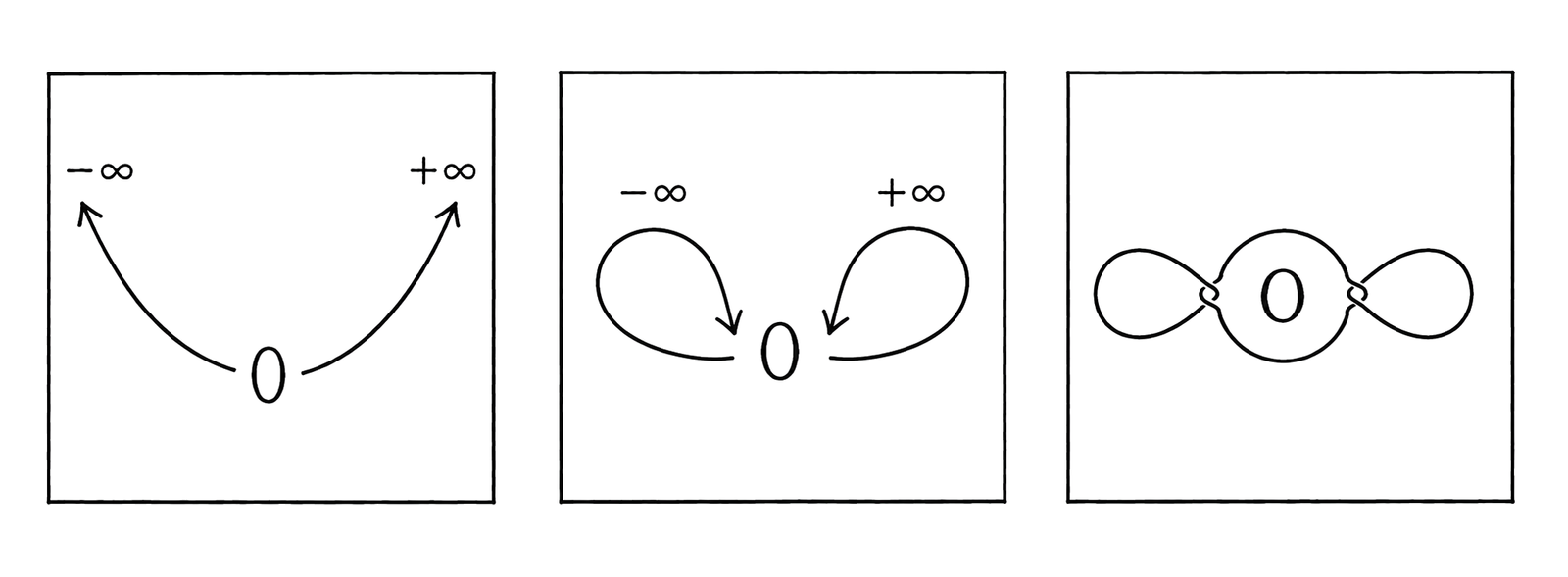
The construction begins with a transformation of an open linear representation into a closed circular structure. The resulting object is called the Transcendental Node:
The transformation does not treat zero and infinity as interchangeable numerical values. It investigates the structural relations among numerical zero, the two limiting directions, circular closure, and Origin. The drawing above presents this operation visually as the knotting of the Transcendental Node. Its expanded mathematical definitions, distinctions, and tests are developed throughout the chapters and in the manuscript linked below.
The second concept entering the investigation is [Ma]:
[Ma] denotes the recursive possibility that remains unresolved relative to a selected finite terminal resolution N. As resolution increases, [Ma] decreases. The statement [Ma]N = 0 means that no recursive work required by the defined construction remains unresolved at that resolution; it does not mean that infinity or every possible mathematical refinement has been exhausted.
The technical objective is to follow the Transcendental Node through successive functions: first as a Model, then as a Realm, a Telescope, a Clock, and eventually a Laboratory. Metaphors are used as instruments of research and navigation, but each is translated into explicit mathematical distinctions wherever the investigation requires formal meaning.
Established mathematics already contains several ways of organizing infinity within a defined representation. The extended real line adjoins two infinite directions; the projective line and the Riemann sphere provide forms of closure in which infinity receives a specified mathematical place. These constructions are precedents for the present investigation, but they are not identical to the proposed model. The Transcendental Node asks whether zero and the two infinite directions can be brought into one structural relation at Origin without being declared numerically identical.
The title Circumnavigating Infinity names the larger quest of the book: whether mathematics can proceed within a finite and operationally closed Realm while infinity remains acknowledged but is moved outside ordinary computation. Infinity is neither denied nor treated as a reachable number. It is placed at the margin of the working model, allowing definitions, transformations, observations, and eventually engineering to proceed without infinity dominating every operation.
Circumnavigation therefore means both journey and mapping. The investigation travels around infinity to determine its position, boundaries, effects, and relations rather than attempting to arrive at it. Its longer objective is a possible calculus of infinity: a framework in which infinity has a precisely organized place while mathematical objects and operations acquire a defined degree of independence from it. This book tests whether the Transcendental Node can provide the first workable object for that wider project.
A concise historical context for this investigation is presented in the appendix A Short History of Infinity and Zero. The article, together with the chapters of the book, is available through the public project folder: Appendix_A_Short_History_of_Infinity_and_Zero.pdf .
Chapters' content
● Point
Transcendental Node and [Ma]
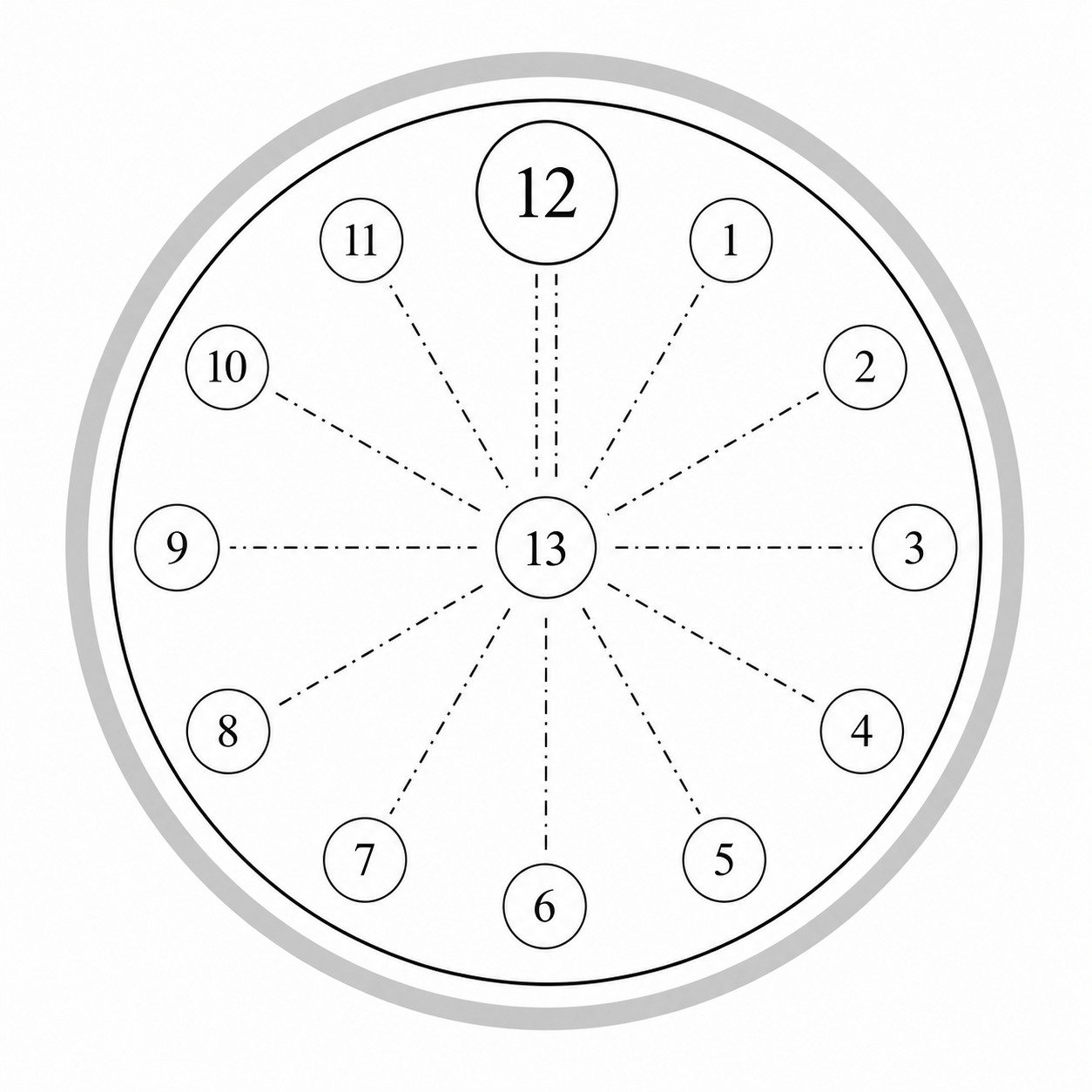
The book begins with the Transcendental Node and [Ma], introduced in the Entry Gate above. At ● Point, they enter the mathematical investigation as proposed concepts rather than established results. The chapters that follow define, construct, test, and revise them within Circular Mathematics.
Below, we present selected excerpts from the book. As the manuscript is currently under revision, open access to its nearly complete content is available through the Google Drive link provided here.
Please note that this work is the intellectual property of the Museum of Hearth. You are welcome to read it and refer to its ideas. When quoting, sharing, or otherwise using any part of the work, please give appropriate credit to Museum of Hearth or to the author - Mac Waves.
Chapter 1
The Mathematical Line
The investigation begins with the familiar mathematical landscape: the real number line, zero as reference, positive and negative directions, the Cartesian and complex planes, and extension toward infinity. By distinguishing mathematical territory from its representations, the chapter asks whether an unbounded structure can be given a closed map without confusing infinity with an ordinary finite endpoint.
Chapter 2
Transcendental Node as Model
The conceptual structure introduced at Point is developed as a mathematical Model. Beginning with the extended real axis, the chapter distinguishes numerical zero, infinite limiting directions, structural Origin ⊙, equivalence, projection, and circular closure. It asks what relations can legitimately be preserved when an open linear representation is transformed into a closed recursive map.
Chapter 3
The Circular Realm
Transcendental Node becomes a mathematical environment. Recursive resolution, Athoms, and [Ma] define a Circular Realm capable of reaching completion at a selected finite terminal resolution N. Completion means that every distinction required by the construction has become terminal while Origin ⊙, complementary branches, balance, and common closure remain preserved.
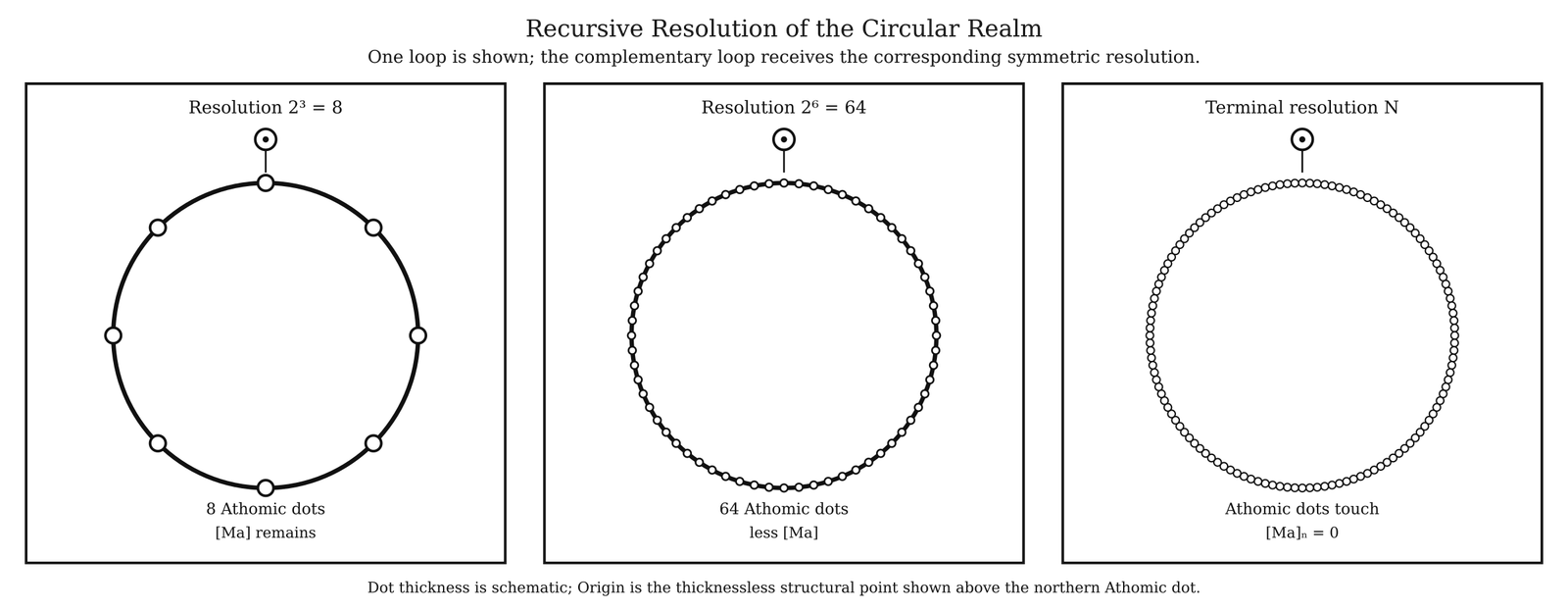
Excerpt from Chapter 3 — The Circular Realm
Definition of the Circular Realm
The Circular Realm at terminal resolution N is the structured object
ℜN = (𝔗, ⊙, ρ, D, N, 𝒜N, [Ma])
where:
- 𝔗 = L− ∨⊙ L+ is the Transcendental Node as the closed two-loop Model;
- ⊙ is the invariant structural Origin;
- ρ exchanges the complementary loops;
- D is the recursive binary subdivision rule;
- N is the selected finite terminal resolution;
- 𝒜N is the finite set of Athoms, each represented by an Athomic dot with an associated terminal cell;
- [Ma] records the unresolved required recursive possibility and satisfies [Ma]N = 0.
This definition establishes the Realm without introducing a new number, a new arithmetic, or a claim that mathematical infinity has been eliminated.
Status of the Realm
This chapter establishes the following components:
- The two-loop quotient constructed in Chapter 2 is the underlying Model of the Realm.
- Binary midpoint subdivision produces 2k cells on each loop at every finite resolution k.
- Local reflection and global loop reflection are preserved under symmetric subdivision.
- A selected finite N defines the terminal resolution required by a particular construction.
- An Athom is represented by a visible Athomic dot together with its associated terminal cell.
- The structural Origin remains a thicknessless invariant point. It is not itself an Athom, even where an Athomic dot shares its location.
- [Ma] records unresolved required recursion and reaches [Ma]N = 0 at completion.
- Terminal Athomic cells provide a finite covering of each closed loop while leaving the underlying mathematical territory unchanged.
These statements establish the Circular Realm.
Chapter 4
The Telescope
Circular Realm changes function and becomes an instrument of observation. Telescope-k represents an existing mathematical object at a selected finite resolution k, making complementary paths, reflection, invariant midpoints, and local structure visible without changing the object itself. The distinction between finite observation and mathematical proof is established before Telescope is directed toward functions.
Chapter 5
Watching the Mountain
Telescope is directed toward its first complex mathematical landscape: the Riemann zeta function. Its pole, zeros, reflection structure, critical strip, critical line, and behavior under changing resolutions are observed without assuming a destination or claiming a proof. The purpose is to test what Circular representation reveals and where its observational limits lie.
Chapter 6
The Opposite Position — The Wall of Zeros
Observation repeatedly carries the real coordinate of the non-trivial zeros known on the critical line to one persistent circular position opposite the local Origin. The distribution of the remaining non-trivial zeros and the question expressed by the Riemann Hypothesis form a Wall that cannot be crossed through finite observation alone. Instead of forcing an answer, the investigation changes direction—from observing an exterior map to engineering an instrument capable of studying how mathematical structure unfolds.
Chapter 7
Transcendental Node as Machine — The Clock
Transcendental Node changes from Telescope to Machine. To study a mathematical function as a developing structure rather than only through its completed representation, the chapter constructs the Clock: an instrument that records recursive unfolding through successive finite resolutions from K toward terminal resolution N. The function is approached through increasingly condensed generative information so that its unfolding can later be conducted and observed inside the finite Circular Realm. Completion at [Ma]N = 0 closes the selected cycle and opens the Gate to a possible next level of observation.
Chapter 7+i
Magic Mirror
-
7+i — Visual Mathematics
The Wall of Zeros through Telescope-K and Telescope-N.
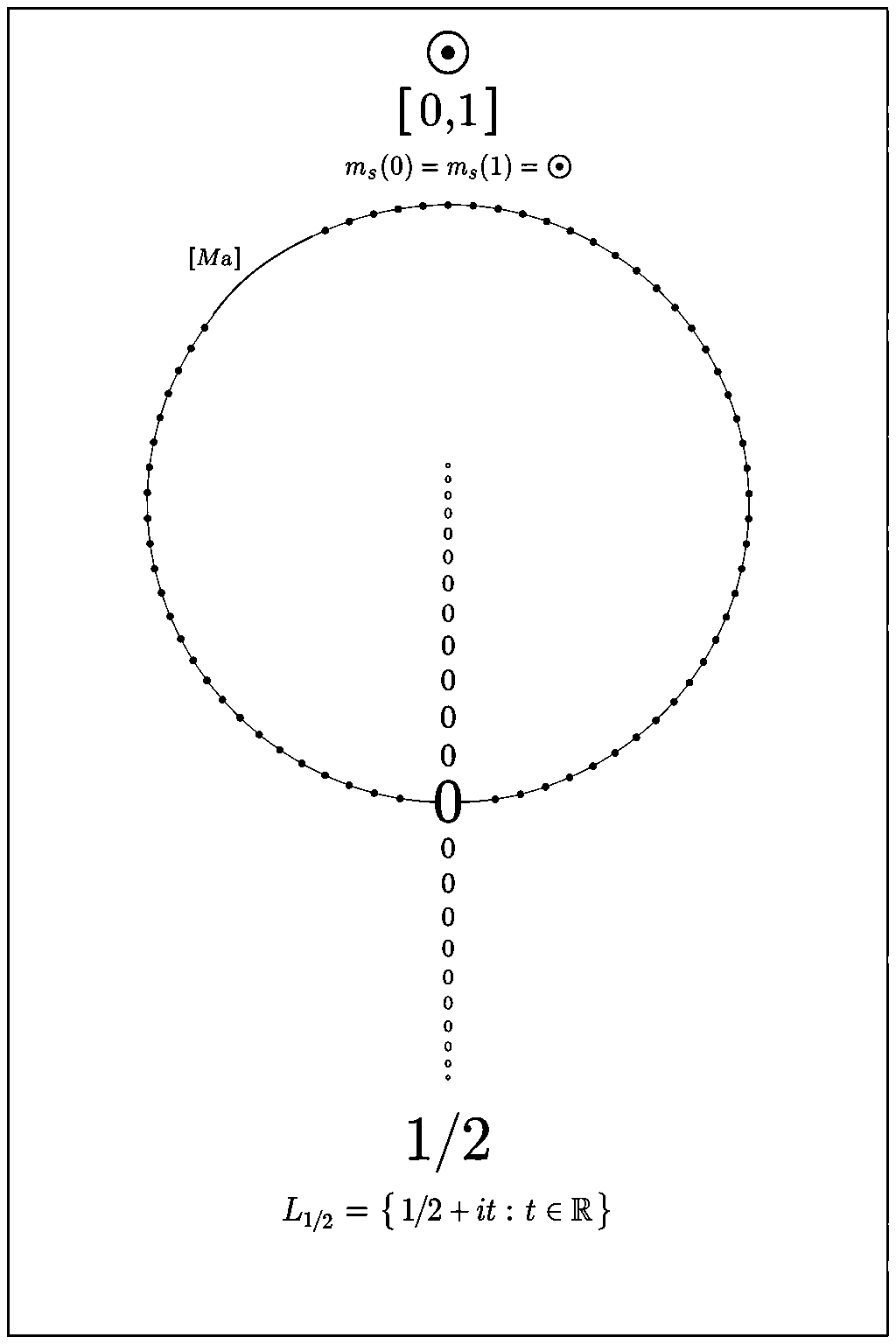 Telescope-K — The Wall of Zeros
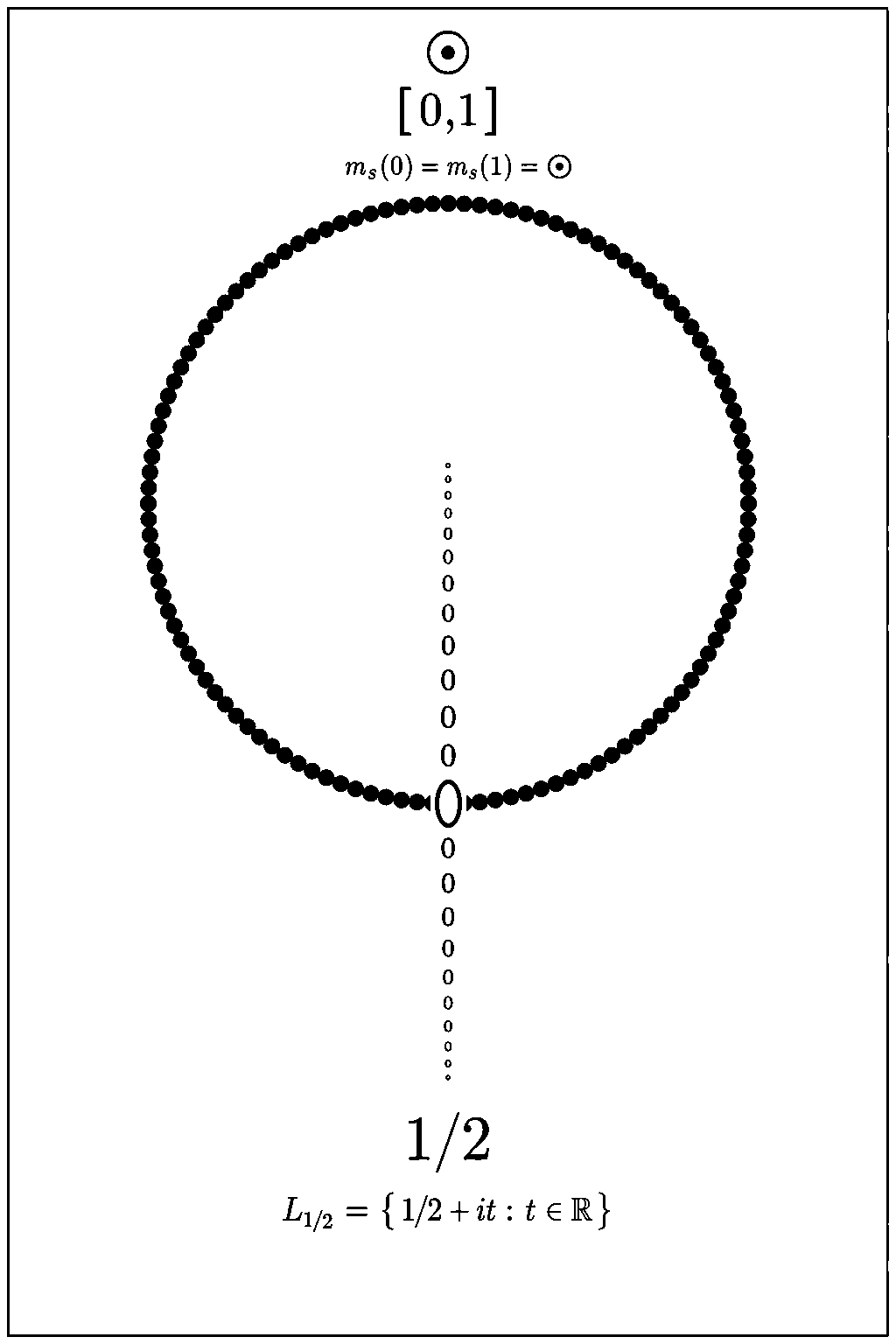 Telescope-N — The Wall of Zeros
 -
7.2+i — Beyond Mathematics
Relation, counterpoints, annihilation, construction, wholeness and equilibrium.
-
7.3+i — Magic Mirror
The rune 𝔐 and the invisible governance of equilibrium.
-
7.4+i — The Butterfly
Pointed Origin and Butterfly as minimum and maximum manifestations of Relation.
-
7.5+i — The Seed returns from the Future
The candidate zeta Seed is reconstructed, tested and reduced.
-
7.6+i — Destructive and Constructive Zeros
Zeros as annihilation traces and possible carriers of constructive information.
-
7.7+i — Map & Function
Map-Origin, function-pole, equilibrium and the center at 1/2.
-
7.8+i — Elementary
The same drawings return, completing the voyage around infinity.
Chapter 8
The Quest for the Seed
With the Clock constructed, the investigation searches for the minimal structural information capable of entering it and unfolding without losing the identity of the mathematical object. Origin, duality, reflection, balance, closure, backbone, and unique unfolding are examined as possible components of a future Seed. The result is not declared a completed universal object, but developed as a provisional structure whose necessary content must be discovered through further testing.
Chapter 9
Primes
Prime numbers provide another territory in which to test Circular representation. Established prime-number structures are distinguished from experimental observations involving recursive resolution, [PRIMES], [ANTI-PRIMES], and the proposed Butterfly construction. The chapter explores whether the language of primes reveals relations hidden by linear or conventional numerical maps.
Chapter 10
Transcendental Node as Laboratory
Revision in progress. The investigation returns to the principal development of Transcendental Node and asks what can emerge after its construction as Realm, Telescope, and Clock. The provisional next level is a reusable mathematical Laboratory: an architecture in which different objects can be admitted, represented, unfolded, compared, and tested without confusing the instrument with the objects passing through it.
Chapter 11
The Seed
Revision in progress. The investigation returns to the question of minimal generative information after the Transcendental Node has been developed as a working instrument. The chapter asks what a mathematical Seed must preserve, what may arise only during unfolding, and whether different mathematical objects require distinct Seeds operating through a shared structural grammar. The Seed remains a research object rather than a completed universal formula.
Chapter 12
The Completed Circle
Revision in progress. The investigation returns to Transcendental Node and reviews the structures developed from it: Model, Circular Realm, Telescope, Machine, Clock, Gate, Laboratory, and the possible Seed. Definitions and established mathematics are separated from observations, axioms, model constructions, conjectures, and open questions. The present circle closes at its selected resolution while leaving the Gate open toward a wider theory of Circular Mathematics.
Transformations
Problems
[ ● ]
The Hidden Ring
Calculus of [Ma]
Appendices
Foreword
The Entry Gate introduces the two concepts carried into this investigation: the Transcendental Node and [Ma]. This Foreword does not repeat their definitions. It describes the elementary mathematical object from which the investigation begins and the method by which that object is followed through increasingly complex transformations.
The author’s independent research practice, the instruments drawn from the history of art and direct observation of Nature, and the declared collaboration with ChatGPT are presented more fully in the Humanist Introduction to CRYSTAL 333 . Here, attention remains on the specific mathematical starting point of this book.
The Circle as Reference
The principal reference of Circular Mathematics is the circle. It is among the oldest and simplest mathematical objects, yet it carries several elementary relations that remain active throughout mathematics:
C = πd = 2πr
r = d/2
2π radians = one complete rotation
Geometrically, the circle is a closed whole. It has a center, a circumference, a radius equal to one half of its diameter, and the constant π connecting its linear measurements with circular closure.
Circular Mathematics begins by looking again at these familiar relations. A point may be associated conceptually with zero, but a point is not thereby declared numerically identical to zero. A complete circle may be read as one whole, but this observation is not inserted into arithmetic as a new numerical identity. The relation between radius and diameter gives the elementary position 1/2. The circumference introduces π. These relations provide the first coordinates of the investigation: Origin, zero, one whole, 1/2, and π.
The segment from 0 to 1 can be placed upon a circle, with its endpoints meeting at a distinguished Origin. The open direction of the line is thereby translated into a closed path. The circle remains one continuous line, yet it may be circulated without a final traversal. This does not give the circle an infinite circumference. It distinguishes a finite closed object from the indefinitely repeatable movement that can occur upon it.
Established Precedents and the Proposed Difference
Established mathematics already contains several rigorous relations between lines, circles, closure, and infinity. Periodic identification produces the circle group:
The one-point compactification of the real line is homeomorphic to a circle. The real projective line closes the real line with a point at infinity, while the Riemann sphere extends the complex plane by one point at infinity.
These constructions provide essential precedents, but the Transcendental Node is not presented as another name for any one of them. Its proposed structure places numerical zero and the two infinite directions into one distinguished equivalence class represented by the Pointed Origin ⊙, while retaining two complementary loops joined at that Origin. The purpose is not merely topological closure. It is to test whether the resulting object can support recursive resolution, observation, transformation, and eventually finite mathematical engineering.
The Circle as Translator
The circle also acts as a translator between geometry and analysis. This role is examined in the project’s article Mathematical Archaeology: Following Structure Through Transformations — The Journey of π from the Circle to the Zeta Functional Equation.
The article begins with the elementary relation C = 2πr and follows π through a chain of established transformations:
circle → circular phase → Fourier analysis → integer lattice → Gaussian → theta reciprocity → Mellin transformation → zeta reflection
The stages are not treated as identical. Each uses a different mathematical language. What matters is that a structural ancestry can survive translation.
The real line becomes circular phase through periodic identification. Translation becomes multiplication by phase in Fourier analysis. Periodicity produces integer harmonic modes. The Gaussian introduces Fourier self-duality; Poisson summation transfers this duality to the integer lattice; the theta function produces reciprocal-scale symmetry; and the Mellin transform carries that symmetry into the completed zeta functional equation.
This archaeological route does not claim that the Riemann zeta function is derived from the elementary circle alone. It demonstrates that circular, harmonic, scaling, and reflective structures remain connected through a rigorous sequence of established transformations. The circle is therefore not merely an illustration placed beside analysis. It is one of the elementary ancestors whose relations remain legible inside a mature analytic object.
The Fresh Look
The method of this investigation is to begin with what appears elementary and ask what has become invisible through familiarity. The circle is observed first as a point, a center, a radius, a diameter, a circumference, a whole, a half, a closure, and a repeatable path. These observations remain conceptual until a mathematical construction gives them a precise role.
This temporary return to elementary observation does not replace established mathematics. It provides questions for established mathematics to test. Imagination proposes a possible route; mathematical verification determines whether the route exists.
The project’s current formal state of research is presented in The Wall of Zeros: A State of Research and a Circular Mathematics Approach. The article reconstructs the established path from circular phase to the completed zeta function, develops the equal-distance geometry of the critical line, and states precisely where the Circular Mathematics interpretation ends and the unresolved analytic problem begins. It does not claim a proof of the Riemann Hypothesis.
Mathematical Archaeology and The Wall of Zeros, together with the chapters and appendices of this book, are available in the project’s public Google Drive folder . The historical appendix is being expanded under the title A Short History of Infinity, Zero and the Circle.
Acknowledgement
This book and research is dedicated to Ferdinand Magellan.
&&&
I would like to express my appreciation to all mathematicians and naturalists who, with or without formal academic credentials, have brought something new to science through independent observation, curiosity, and investigation.
Particularly, I wish to acknowledge:
Grigori Perelman, for emphasizing that the primary objective of Mathematics is to solve the problem.
&
Connecting this independent research with my biological life, I would like to thank:
Professor Wiesław, my father, my first guide in the process of learning a foreign language, therefore my first professor of translation.
Kazimierz, my grandfather, my first teacher of Fractal Time.
Marek, Profesor Urojony, my first teacher of Bridge, the card game.
And, last but not least,
Anna, my sister,
and Casa Guayabo in San Pancho, for supporting the biological continuity of Mac Waves.
&&&
I would like to express my gratitude to all women with whom I shared the alchemy of love, where orgasm may be seen as the most direct human experience of the Magic Mirror.
Afterword
(Excerpt from the Afterword. The complete Afterword is available in the link to Museum of Hearth 's Google Drive provided above.)
Let us imagine a primary school sometime in the future.
In the middle of the room, children are playing with projections of mathematical objects that today require years of specialized study to approach. They rotate them, enter them, change the scale, and follow their symmetries. The objects are complex, but to the children they may simply be beautiful.
One of the objects is the Riemann zeta function.
A teacher looks at its visualization and asks:
“If this object represents one of the two wings of a butterfly, where on the map of numbers would its body be located?”
A child looks at it for a moment.
“There.”
Halfway between zero and one. At the line passing through the middle.
“Why?”
“Because that is where the butterfly's body can form itself and then become alive.” *
For this future child, this is enough.
* In biological terminology, the insect body consists of three principal regions: the head—sensory and feeding center; the thorax—center of locomotion, bearing the wings and legs; and the abdomen—containing the principal internal systems supporting life.
&&&
The mathematical objects are still floating in the classroom. The children move around them, rotate them, enter them, and play with their symmetries.
Through the windows we see the ocean.
On the beach below, two children—a girl and a boy—are playing together with kites.
The kites are butterflies.
The butterflies-kites are whirling above the beach, carried by the air between the land and the ocean, while the girl and the boy circle around each other...
&&&
"TRANSCENDENTAL NODE" — Structure Alpha & Beta
"Circumnavigating Infinity — Transcendental Node as an Application of Circular Mathematics"
● — Two Concepts Entering the Investigation
Chapter 1 (Observation) — The Mathematical Line
Chapter 2 (Model) — The Transcendental Node
Chapter 3 (Realm) — The Circular Realm
Chapter 4 (Tool) — The Telescope
Chapter 5 (Observations with the Tool) — Watching the Mountain
Chapter 6 (Border-Moment) — The Wall of Zeros
Chapter 7 (Engineering) — Transcendental Node as Machine — The Clock
Chapter 8 (The Quest) — The Quest for the tote Seed
Chapter 9 (Runes) — Primes
Chapter 10 (Laboratory) — Transcendental Node as Laboratory
Chapter 11 (Applications) — Transformations
Chapter 12 (Closing the Set) — The Completed Circle
&&&
Chapter 13 (Around the Horizon) — 13 Exercises